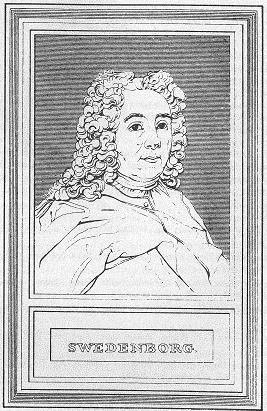
Wednesday, 10 February 2010

Tortoises in Swedenborg's writings


Apocalypse Revealed 463

To this I will add this Relation. I looked forth to the seacoast in the spiritual world, and saw there a magnificent dock. I drew near, and looked at it; and, behold, there were vessels there great and small, and merchandise in them of every kind; and upon the decks were boys and girls distributing it to those that wished. And they said, "We are waiting to see our beautiful tortoises, which now and then rise up to us out of the sea." And, behold, I saw tortoises great and small, upon whose shells and scales young tortoises were sitting, which were looking at the islands around. The father tortoises had two heads, the one large, covered over with a shell similar to the shell of their body, whence they had a reddish glow; and the other small, such as tortoises have, which they drew back into the front parts of the body, and also to insert in an unobserved manner in the larger head. But I kept my eyes on the great reddish head; and I saw that this had a face like a man, and spoke with the boys and girls upon the decks, and licked their hands. And the boys and girls then stroked them, and gave them eatables and dainties, and also costly things, as pure silk for garments, thyine wood for tablets, purple for decorations, and scarlet for paints. [2] Seeing these things, I desired to know what they represented; as I knew that all the things that appear in the world of spirits are correspondences, and represent something spiritual coming down from heaven. And they then spoke with me out of heaven, and said, "You yourself know what the dock represents, also what the ships, and the boys and the girls upon the decks; but you do not know what the tortoises represent." And they said, "The tortoises represent those of the clergy there, who altogether separate faith from charity and its good works, affirming in themselves that there is plainly no conjunction between them; but that the Holy Spirit, through faith in God the Father for the sake of the Son's merit, enters into a man, and purifies his interiors even to his own will, out of which they make as it were an oval plane; and that when the operation of the Holy Spirit approaches this plane, it bends itself around it on the left side, and does not at all touch it: and thus that the interior or higher part of a man's nature is for God, and that the exterior or lower is for man; and that thus nothing that the man does, neither good nor evil, appears before God: not the good, because this is meritorious; and not the evil, because this is evil; since, if these appeared before God, the man would perish from both; and since it is so, that man is permitted to will, think, speak, and do whatever he pleases, provided he is careful before the world."


True Christian Religion 443

...from the morality of the external man, no one can form any conclusion as to the morality of the internal, since this may be turned in an opposite direction, and may hide itself as a tortoise hides its head within its shell, or as a serpent hides its head in its coil.

Saturday, 23 January 2010

Henry James Snr. & Swedenborg

Martin E. Marty, in his introduction to William James' iconic book The Varieties of Religious Experience, has this to say about Henry Snr., father of William and Henry:

"Henry Senior found resources for making his break from old-style Calvinism in the writings of the mystic Emanuel Swedenborg, who was then enjoying a vogue in the United States. With the aid of Swedenborg and his own instinctive talent, the elder James fused old religion and new into a private blend..."

Sunday, 3 January 2010

The roots of the New Age


From Peter Clarke's fascinating book New Religions in Global Perspective (2006):

"The writings of Emanuel Swedenborg...are among the principle sources of New Age thinking, in particular his metaphysical theology, which is an attempt to unravel the inner sense or spiritual sense of the scriptures."

Sunday, 29 November 2009

Helen Keller

Helen Keller continues to inspire generations of people, but still very few know about her lifelong love of the writings of Emanuel Swedenborg.
In a beautiful book she wrote on the subject, Light in My Darkness (originally published in 1927 as My Religion), Keller lays out how very much Swedenborg's ideas influenced her and helped her to make the best of her extraordinary life. The Swedenborg Foundation has also produced an absolutely fascinating documentary film of her life called Shining Soul which is well worth seeing.
Keller's advocacy of Swedenborg was a result of some influential mentors in her life who were themselves prominent Swedenborgians. She was given access to braille editions of Swedenborg's writings, and in them she found great spiritual solace.

Tuesday, 13 October 2009

The Swedenborg Whale


Science News: Prehistoric Whale Discovered On The West Coast Of Sweden

ScienceDaily (June 8, 2009)

The skeleton of a whale that died around 10,000 years ago has been found in connection with the extension of the E6 motorway in Strömstad. The whale bones are now being examined by researchers at the University of Gothenburg who, among other things, want to ascertain whether the find is the mystical "Swedenborg whale".

There are currently four species of right whale. What is particularly interesting is that the size and shape of the whale bones resemble those of a fifth species: the mystical "Swedenborg whale", first described by the scientist Emmanuel Swedenborg in the 18th century.

"Bones from what is believed to be Swedenborg's right whale have previously been found in western Sweden. However, determining the species of whale bones found in earth is complicated and there is no definitive conclusion on whether the whale actually existed, it could equally well be a myth," says zoologist Thomas Dahlgren and his colleague Leif Jonsson.

DNA tests conducted

To determine the species of whale that has been found Thomas Dahlgren has conducted DNA tests that are to be analysed in conjunction with researchers at the Natural History Museum in London. The whale bones are interesting in several respects. The fragments of bone were collected in a clay deposit and remains of marine organisms that today are also endangered species were found around them.

"The hunt for the large whale species, which led to the extinction of the Atlantic grey whale and perhaps the Swedenborg whale, may also have caused the extinction of a large number of species that are dependent on whale carcasses for their survival," says Thomas Dahlgren.

Preserved in clay

The whale bones are thought to be around 10,000 years old and were found 75 metres above sea level, but in a site that at that time was located out on the coast. It is conjectured that the bones have been preserved for such a long time as they were surrounded by fine, oxygen-free clay. The largest whale bone, approximately 2.5 metres long, is part of a jawbone. Among the smaller bones is a vertebra. Discussions are underway on whether the bones can be put in order and potentially put on public display.

Facts about the Swedenborg whale (Balaena Swedenborgii)

The whale species is believed to have existed in the North Sea from the period when the inland ice melted until about 8,000 years ago, and subsequently to have died out. Ten collections of bones from the species have been found in the west of Sweden. However, there is speculation that the bones have been mistaken for other species, and that the Swedenborg whale never existed. Source: Swedish National Encyclopedia

Adapted from materials provided by University of Gothenburg.


Whale cartoon: http://cidutest.files.wordpress.com/2007/08/whalesongs.gif

Friday, 11 September 2009

Swedenborg & the Paranormal


If you looked at the Google home page a few days ago you would have noticed their logo had been playfully altered to show a UFO hovering over the letters while it beamed up the second letter O in "Google." For other creative past Google logos, see http://www.google-logos.com/category/official-google-logos

Clicking on their UFO logo revealed a searchlist of numerous things paranormal. One of the items of note was a LiveScience countdown list of the current top ten unexplained phenomena - see http://www.livescience.com/strangenews/top10_unexplained_phenomena-1.html

The listed top ten unexplained phenomena are (more details on each at their site):

10. The Body/Mind Connection
9. Psychic powers and ESP
8. Near-Death Experiences and Life After Death
7. UFOs
6. Deja vu
5. Ghosts
4. Mysterious Disappearances
3. Intuition
2. Bigfoot
1. The Taos Hum

I think that Emanuel Swedenborg is often unfairly singled out in the popular mind as being an authority on the paranormal. While it's true that he enjoyed considerable paranormal gifts, I think he would have been the first to dismiss the importance of these as pursuits in their own right.

Swedenborg was primarily interested in his later life in exploring and recording honestly and faithfully the things he was given to see and experience about the spiritual world and realm of the soul. His former scientific achievements and fame for his intellectual capacity in fields at the forefront of science of his day, plus his service to the Swedish House of Nobles, the Swedish king and to the Board of Mines should serve as testament of his sanity.

But then I also think of the value of Swedenborg's material in helping put into a healthy perspective what are regarded as the important outstanding questions of our time. Swedenborg presents a vast cosmology and framework of a plausible harmonious and orderly reality which allows these questions to exist without the need to go into scientific denial and his work even goes a long way to answering them (well, perhaps all except items 7, 2, and 1).

By comparison, even a more orthodox scientific community listed the top unanswered science questions. On 18th November 2006, the reputable New Scientist magazine decided to celebrate their 50th birthday by tackling "the truly big questions" with the help of some of the leading lights in science. They titled their piece The biggest questions ever asked.
See http://www.newscientist.com/article/mg19225780.068-the-biggest-questions-ever-asked.html

The questions posed in the New Scientist were:

1. What is reality?
2. What is life?
3. Do we have free will?
4. Is the universe deterministic?
5. What is consciousness?
6. Will we ever have a theory of everything?
7. What happens after you die?

These seem to complement the unsolved mystery list mentioned above rather nicely. And if you study Swedenborg's writings, my guess is that you would probably agree that Swedenborg goes a long way in helping put such question into a healthy perspective which can provide some very satisfying answers or at least a very clear framework for deciding the importance of such matters.

Anyhow, happy pondering.

Tuesday, 8 September 2009

New Director of Swedenborg Centre, Sydney


Michael Chester will be taking up the position of Director of the Swedenborg Centre when Neville Jarvis retires at the end of December. Michael has been closely involved with the work of the Swedenborg Centre for many years. He was a foundation member of the Swedenborg Association of Australia and its Secretary for 6 years.
Michael has a deep understanding of the writings of Swedenborg and of the teachings of the New Church, and it is his wish to make these as available and known to people out there as possible, and to help people see their relevance and use in their lives.
Michael also brings other skills to the position that he will take up. He is a trained teacher in science and maths; he has a personal interest in and understanding of yoga and of other spiritual approaches and practices.
He will take over duties at the end of this year, following the retirement of Neville Jarvis, who has served as the Director for many years, and contributed so much to the growth and spread of Swedenborg's spiritual writings during his time here.
Neville and his wife Alexis will be sorely missed, but we look forward as well to the new energy and unique input of Michael.